"Predatory Man of Wealth" -- Theodore Roosevelt (Tucker, 2008)
J.P. Morgan's success naturally lends him towards criticism for being a cutthroat businessman, or, in Theodore Roosevelt's words, a "predatory man of wealth." He was bold and unrelenting in his business affairs from the beginning. His speculation during the Civil War earned him a yearly income of $50,000 at a time when the average skilled laborer earned $500 (Brands, 2010). However, a huge amount of J.P. Morgan's success can be attributed to his great influence in the growth of railroads. Biographer Jean Strouse notes, "Railroads weren't a sure thing. Some turned out to be Microsoft, and some turned out to be Enron" (Timmons, 2002, 124). Hence, Morgan's adventures in railroads were risky, and the railroad business was chaotic. Private railroad lines would pop up all across the United States, but they would compete with each other to the detriment of practicality. Therefore, two railroad lines were often being built parallel to each other because they were controlled by different railroad companies. Seeing this impracticality, J.P. Morgan worked his way onto the Board of Directors for several major railroad lines. After holding a summit at his home, J.P. Morgan essentially organized a gigantic railroad trust which forced the different lines to collaborate and perform their business much more efficiently (Brands, 2010). This process of reorganization became known as "Morganization," and can be applied to a similar simplification and consolidation of any business (Samuelson, 2002, p.43).
J.P. Morgan used his wealth to create the first one billion dollar corporation in America, United States Steel, in 1901 (Chernow, 1998). When Morgan made a $480 million offer to Carnegie to purchase his steel company, journalist and historian Henry Adams stated, "Pierpont Morgan is apparently trying to swallow the sun" (Lingeman, 1999). He must have succeeded, for U.S. Steel controlled sixty percent of the American steel market (Gordon, 1989). Of course, this maneuver raised criticism against trusts and their potential to completely monopolize markets and control the economy. J.P. Morgan also engineered the mergers of other well-known, to this day, corporations such as American Telephone and Telegraph and General Electric (Tucker, 2008).
 |
|


Spurred on by Morgan's creation of these numerous trusts and corporations, people, particularly political groups such as the Progressives, criticized J.P. Morgan for his self-serving views and practices. For example, he favored the gold standard because it helped big businesses and banks maintain a high value on their dollar. Additionally, his desire to increase industrial growth at all costs hurt farmers, small businesses, and shippers because he would curb competition in order to increase the payoff to his investors (Samuelson, 2002, p.43).
Therefore, while many questioned and criticized all that J.P. Morgan embodied, it is undeniable that his decisive business sense and his massive wealth played a fundamental role in saving the United States as it faced recession.
It's All in a Photograph Photographer Edward Steichen captured one of the most famous portraits of J.P. Morgan in 1903. Morgan, who often had self-portraits commissioned, rarely had or made time to sit an adequate amount of time for these portraits. He was a busy man, and when Steichen, who had already taken one photograph, asked him to reposition himself slightly, Morgan became frustrated. Seeing the change in countenance, Steichen immediately captured another photograph, and it is this photograph (right) which so defines J.P. Morgan's personality. His brow is furrowed, his mustache makes it look like he is frowning, and the arm of the chair looks like a dagger. When Morgan saw the proof, he immediately tore it up (Tucker, 2011, p.7). Steichen, however, recognized the artistic treasure that he had, and his photo played off of the general population's ideas about the cutthroat nature of Wall Street businessmen. Biographer Jean Strouse notes, "He looks like a well-dressed pirate. Photographs don't lie - there is that in him" (Tucker, 2011, p.8). |  Photograph: (Tucker, 2011, p.6) |
J.P. Morgan's formidable presence made a clear impression on Edward Steichen. Not only was Morgan's tall and rotund frame intimidating, but his gaze really caught Steichen's attention. He compared it to the headlights of an express train - "If one could step off the track, they were merely awe inspiring; if one could not, they were terrifying" (Gordon, 1989).
Man of Honor
Despite public perception that J.P. Morgan represented all that was cruel and self-serving in Wall Street, one could argue that he served as a rare example of true honor in the business world. J.P. Morgan had witnessed the corruption that can result from government interfering with business, as it did with Boss Tweed in New York (Gordon, 1989). Therefore, he strongly opposed government regulation in business, but yet he firmly believed that businesses should regulate themselves. In the late 1800s, businessmen like J.P. Morgan insisted that publicly held corporations hire independent accountants and publish quarterly reports (Gordon, 1989). This made businesses more open and honest with their investors, although businesses today continue to struggle with that very concept despite the numerous government-enforced regulations. J.P. Morgan also took care of those involved with his business. He viewed the investors' money as his own, while today's business overlords tend to see it as a "commodity to be pursued and processed - but not necessarily protected" (Samuelson, 2002, p.43).
He believed in the Gospel of Wealth, an idea formulated by Andrew Carnegie, another great businessman who was a contemporary of J.P. Morgan. This idea stipulates that the rich should take their wealth and use it to benefit all of society (Newman & Schmalbach, 2004, p.339). That said, J.P. Morgan was not so wholly devoted to his business and his wealth. He frequently left New York on extended vacations, stating, "I can do a year's work in nine months, but not twelve" (Gordon, 1989). Hence, more personally, J.P. Morgan showed his compassion in numerous situations. For example, he went to great extents to make up a job for an elderly woman who was afraid of being a charity case. He also feel in love with Amelia "Mimi" Sturges. Unfortunately, she had tuberculosis. Still, Morgan married her in 1861, even though she was too ill to stand during the ceremony. He immediately moved her to a warmer home, abandoning his post on Wall Street, and nursed her health for the remaining four months of her life. When he married a second time, he became a doting father, and he would dress up as Santa Claus every Christmas to amuse his four children (ibid.).
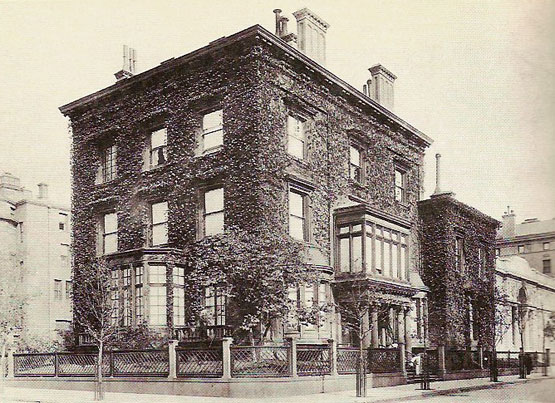 J.P. Morgan's house on 36th and Madison. | J.P. Morgan's character can also be seen in his rather modest display of his wealth. Granted, he had an elaborate collection of art and manuscripts, but he kept a relatively modest household, given his wealth. While Cornelius Vanderbilt II had at least fifty-six staff members in his household, Morgan had only twelve. At that time, even a modest middle-class man might have two or three servants. Additionally, at his death, Morgan's estate (including the value of the art) was only valued at approximately $130 million, making him significantly less rich than John D. Rockefeller, the first billionaire in the United States (Gordon, 1989). While these displays of relative modesty are not a direct reflection on his character, they reflect that J.P. Morgan may not have been so greedy and flashy as other businessmen. |
Finally, J.P. Morgan greatly valued good character in others. When asked how he decided to whom he should loan money, he responded that money and property meant nothing. Rather, it all depended on character:
"I have known a man to come into my office, and I have given him a check for a million dollars when I knew he did not have a cent in the world." --J.P. Morgan (Brands, 2010)
Without this combination of wealth and character, J.P. Morgan would not have been able to help the United States to the extent that he did during the Panics of 1893 and 1907.
Did you know?
J.P. Morgan was obsessed with the size of his nose and his rosacea. This obsession made him hate to be photographed or to speak in public (Tucker, 2011, p.8).
