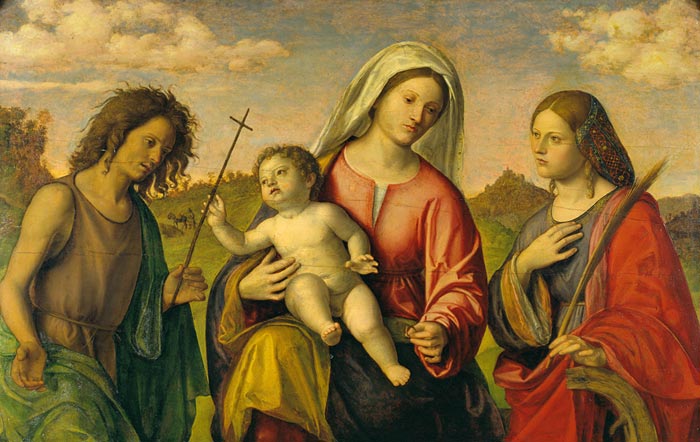
 This Renaissance painting by Battista Caneglioni is among the many valuable works in J.P. Morgan's collection. Courtesy of the Morgan Library. | Art J.P. Morgan spent approximately half of his wealth on his art collection because he so valued beauty and history. At the time of his death, the collection was valued at sixty million dollars. He strongly disliked modern art, and rarely purchased anything that was created past the 1700's. When Morgan arrived at a hotel, art dealers would flock to its lobby to try to make money off of him, for he did not haggle, and he often paid more than the art was worth. Because of his impact on the art market, upon Morgan's death, newspapers headlined: ART DEALERS ALARMED (Gordon, 1989). |
"No price is too great for a work of unquestioned beauty and known authenticity."
-- J.P. Morgan (Tucker, 2011, p.6)
Literature
J.P. Morgan's appreciation for literature can be demonstrated most simply in the fact that he saved the publishing house, Harper and Brothers, from closing because of outstanding debt. Although this deal made no sense financially, and he would not receive a full return on his loan until after his death, Morgan stood by his decision to save the publishing house, stating that it was good for American culture (Gordon, 1989). More complex was his love of collecting fine works of literature.
He had help in developing this collection from his librarian, Bella de Costa Greene. Vivacious and attractive, she did not fit the mold of a typical librarian. She became Morgan's personal shopper, canvasing Europe for the best manuscripts and books. Her influence on the collection earned her the reputation of being "the soul of the Morgan Library" (Gordon, 1999).
Bella de Costa Greene also helped J.P. Morgan expand his art collection. Morgan disliked paying customs on his artwork purchased in Europe to such an extent that he often left the art in one of his homes in England. Knowing this distaste for paying duties, Greene smuggled into the United States a painting, three bronzes, and an expensive watch from London by distracting the customs agents with dutiable goods in her personal luggage. To celebrate this successful tax evasion, Greene told a friend, "When I landed at the library with all of JP's treasures... well he and I did a war dance and laughed in great glee" (Gordon, 1999). How interesting to picture one of the most powerful men on Wall Street dancing with his librarian over smuggling artwork!
In 1902, J.P. Morgan commissioned Charles McKim to design a $1.2 million library for his vast collection. The detail put into the design of the library extended to the marble blocks used in the walls, which were so carefully shaped that they did not require mortar to maintain stability. The collection held within these walls includes numerous illuminated manuscripts, drafts, first editions, and three Gutenberg Bibles (Gordon, 1999). The video (right) discusses the significance of J.P. Morgan's library, the works of literature therein, and the historical events that took place within its walls. |
Find out more about J.P. Morgan's collection and view it in person at the Morgan Library.
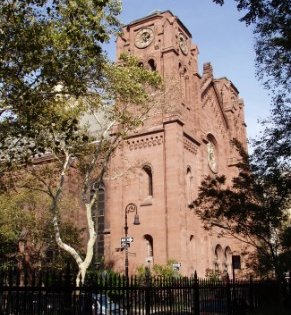 | Did you know? Despite J.P. Morgan's somewhat sordid art smuggling behaviors, he was a regular attender of St. George's Episcopal Church on Stuyvesant Square, a church known for their charity to the poor (Gordon, 1989). |
