Cause
The Panic of 1907 was, in its most simple form, a six-week run on the banks from October to November of 1907 (Tucker, 2008). Similar to the Panic of 1893, there was a chronic gold shortage in the Treasury. However, keeping in line with the nature of business cycles, there had been an economic boom between these two panics.
 | The recession had begun in June 1906, with an earthquake in San Francisco. This natural disaster required significant financial resources to help the city recover, and it sent the stock market into a frenzy. The real trigger for the worst of the panic, however, occurred with the bankruptcy of two large brokerage firms as a result of failed speculation on their parts (ibid.). The devastation in San Francisco (left). Source: BBC News |
J.P. Morgan's Effect
Upon hearing of the dire circumstances in New York, J.P. Morgan, who was spending time in Richmond, Virginia, attached his private Pullman car on a steam engine so that he could travel to the city overnight. On October 20, Morgan organized a reconnaissance mission of sorts to assess the situation on Wall Street. The conclusion of their mission granted that, while some institutions needed to be rescued financially, other should be allowed to fail (Tucker, 2008). This theory on recovery presents a marked difference from how business failures have been managed and bailed out in most recent years.
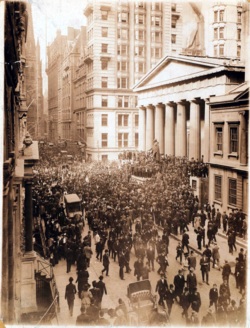 People swarmed Federal Hall on Wall Street when the panic | By October 24, the New York Stock Exchange had only been able to stay open until the end of the day because J.P. Morgan had raised a $24 million loan and had forbidden it to close. He threatened to "properly attend to" any individuals who were attempting to take advantage of the panic and sell people short (Gordon, 1989). That evening, Morgan assembled leading businessmen and bankers in his library to come up with a solution to the impending financial ruin. Morgan played solitaire - one of his favorite pastimes - as the bankers debated over potential solutions. Morgan often rejected such solutions, but finally, around 4 a.m., Morgan's lawyer presented him with a satisfactory plan to put more money in the banks. When Morgan approved of the plan, he had every person who pledged money to the bailout sign. As Edward King of Union Trust signed, Morgan commanded, "There's the place, King, and here's a pen" (Lingeman, 1999). True to Morgan's form, he accepted no nonsense, and he spoke directly and authoritatively. |
It was precisely this authoritative, business-oriented attitude that made J.P. Morgan such a remarkable leader during the Panic of 1907. George Perkins, a business partner, noted, "If there ever was a general in charge of any fight for any people that did more intelligent, courageous work than Mr. Morgan did then, I do not know of it in history" (Gordon, 1989). J.P. Morgan effectively provided a calm within the storm, a force which would be very beneficial during today's economic worried. Those who might provide such leadership, however, are frequently looked at with skepticism (Campbell, 2008, p.44).
The Aftermath J.P. Morgan was not immune from this criticism and skepticism, and his actions during the Panic of 1907 sparked controversy as demonstrated by the political cartoon at right. Some, such as Upton Sinclair, theorized that Morgan had engineered the Panic for his own financial gains. Being proud, and not wanting to waste his time, Morgan ignored such accusations (Gordon, 1989). By the time the 1910 elections came along, the Progressive Movement, which had seriously |  A political cartoon criticizing big bankers. Source: www.fas.harvard.edu |
criticized Morgan for his trust-building and his actions during the Panic of 1907, had gained a lot of momentum. With their influence in Congress, they launched an investigation into Morgan. Feeling the stress from the political happenings, Morgan took more extended vacations. While looking at art in Egypt, Morgan became ill and had to go to Rome for medical treatment. He died rather suddenly on March 31, 1913, at the age of 75 (Brands, 2010). Within the first twelve hours of his death, the Italian hotel in which he died was flooded with 3,698 telegrams from the Pope, emperors, kings, various people in the art world, and, of course, bankers and industrial leaders (Gordon, 1989). His impact had extended to all sectors, beyond mere business, and he had made his mark in the world.
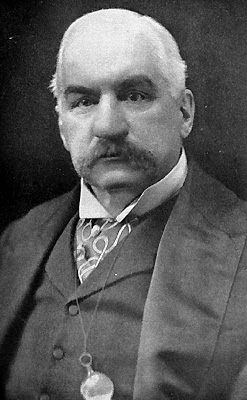 | Some may see Morgan's activity and wonder why it cannot be replicated, or some may wish that Morgan had survived another one hundred years to help with the current financial crisis. Still others, of course, view any such large businessman with extreme disapproval. Yet, there are numerous differences between Morgan'd time and 2011. Most notably, the year of Morgan's death, President Woodrow Wilson passed into law the Federal Reserve Act, which established the Federal Reserve (Gordon, 1989). This central bank might have prevented or minimized the Panics of 1893 and 1907. There are other, more general differences as well. First, today's economic structure is much more complex. It is more difficult to determine where the actual point of failure rests. Second, today's business is conducted much more speedily, with wire transfers and the internet. Finally, the scale of each recession is always different, although the Great Depression is considered to be the worst to date (Tucker, 2008). That said, J.P. Morgan's leadership and influence should not be diminished, and the United States has every reason to be grateful for his actions which ultimately twice saved their economic system. |
The power that Morgan possessed, while may be criticized, earned him his "unique place in American economic history... [and existed] because of both the person he was - a banker of great skill, integrity, and total self-assurance - and the time in which he lived, as the nineteenth century world of private banking and personally managed capital changed into the twentieth-century world of national corporation" (Gordon, 1989).
Did you know?
When J.P. Morgan first arrived at Wall Street, the New York Stock Exchange did not represent a single industrial concern. After fifty years of Morgan's influence, industrial corporations grew to dominate (Gordon, 1989).
